
A startup is a young business built for rapid growth, even while its product and market remain unproven. Neither does age, headcount, nor industry define it, it is the combination of uncertainty and an ambitious growth target. A 4 year old company can still be a startup while a 2 year old venture might have already outgrown the label.
Here, we break down what the term really means, the stages a startup goes through and when it stops applying. We will end with a real-world example.
What Is a Startup Company?
The Short Definition
A startup company is simply a young business built to grow quickly while its product and market are still unproven, the critical word here is unproven. A startup is searching for a scalable business model, not just running one it already has. As Steve Blank described it as a temporary organization built for that search, and Paul Graham reduced it further still, to growth as the single defining property.
What the Definition Does Not Depend On
Neither age, headcount, nor industry matter, a two-person team and a 200-person company can both be startups, so can be a software firm, a water delivery service, or even a hardware manufacturer. What matters is the uncertainty. Startups don’t know for sure who its customer is, what they’ll pay, or if a one-time success can be carried out a thousand times.
Startup Company vs Small Business: The Real Difference
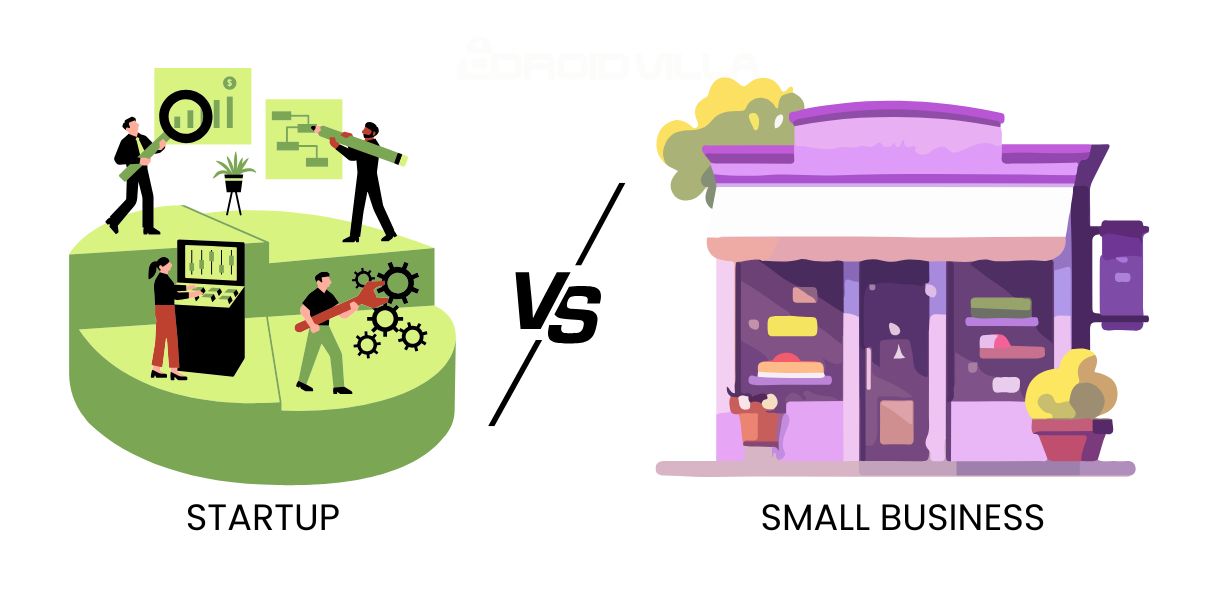
The real difference between a startup company and a small business boils down to intent, not size. Scalable business model is what a startup is actively searching for while a small business is running a model that already works.
Four Tests That Separate Them
| Criterion | Startup | Small business |
| Intended growth rate | Built to grow fast, often many times over in a few years | Built to grow steadily at a size the owner can manage |
| Business model | Still being searched for and tested | Already known and verified by others in the same trade |
| Funding path | Outside capital raised against future growth | Owner savings, bank loans, revenue from day one |
| Success at year five | Operating in several markets on a model that repeats | Profitable, stable and still serving the same market |
What makes a startup is those four criteria, not a simple date of incorporation, a local bakery and a tech company trying to automate household restocking might have the same number of employees in year one but they are totally different kinds of businesses.
The Stages a Startup Company Goes Through
Three stages a startup typically moves through: validation, early traction, and scaling. What changes between them is how much of the business model remains a question.
Idea and Validation
The company is testing if anyone actually wants what they’re building. There are few paying customers, the product is constantly shifting, and the only question that matters is whether the problem is real enough for someone to pay for a solution.
Early Traction
Paying customers exist usually in one city or niche. The company is checking if the pattern holds, this is where a tech startup, one whose core advantage is technology rather than a physical process, starts to prove if its tech can truly scale.
Scaling
The model is tested and trusted and the focus shifts to adding markets, customers, and capacity. Growth now comes from execution, not discovery. This is also when the startup label starts to fade.
A Startup Company Example: Guida

Guida, a Nigerian retailtech company, is a working example of the definition above.
What Guida Does
Guida operates a household subscription service, delivering groceries, table water, and daily essentials to homes and offices on a recurring schedule. Okam Solomon, the founder of Guida, launched the service in Calabar in April 2026, starting with water and expanding into foodstuff. Guida says it has generated ₦3 million in revenue from Calabar. Behind the scenes, an estimation model learns household consumption patterns and predicts what a home will need next. It’s a shift from what you want to buy today to what your household will need next.
Which Stage It Is At
Run Guida against the four tests. Its business model is still evolving. Revenue comes from Calabar, with nothing disclosed beyond that. No funding has been announced, so it’s running on revenue. Its product range has expanded from water to foodstuff and other essentials, showing a company still shaping its offer rather than running a settled trade, this puts Guida at early traction. It has paying customers in one place, but repeatability is still an open question. The estimation model is what makes it a tech startup rather than just a delivery business. Droidvilla covers companies at this stage through Droidvilla Spotlight 2026.
When a Company Is No Longer a Startup
The Markers That Matter
A company stops being a startup when it stops searching for a business model and starts executing one it already trusts. The markers are predictable revenue, product-market fit across multiple markets, a management layer above the founders, and growth through execution rather than discovery, none of these happen overnight, which is why the label fades rather than switches off.
Why There Is No Fixed Number of Years
People often ask how long a company is considered a startup. There is no honest numerical answer. Three, five, and ten years are all thrown around, but none hold up. A company can scale and outgrow the label in four years, or spend eight still searching for the right model. Any page giving you a specific year count is guessing. Watch the markers instead.
Startup Company FAQ
What is a startup company?
A startup company is a young business built to grow quickly while its product and market are still unproven. It’s not defined by age, size, or industry, but by the search for a repeatable, scalable model under uncertainty.
What is the difference between a startup company and a small business?
A small business serves a known market at a steady size. A startup aims to find a model that scales fast. They might look identical in year one, but their intent is completely different.
When is a company no longer a startup?
When it stops searching for a model and starts executing one it trusts. Predictable revenue, repeatable product-market fit, a management layer, and execution-driven growth are the signs. There is no fixed timeframe.
What is an example of a startup company?
Guida, a Nigerian retailtech company founded by Okam Solomon, is one. It launched a household subscription service in Calabar in April 2026, starting with water and adding foodstuff, and the company says it has generated ₦3 million in revenue there.
What is a tech startup company?
A startup whose core advantage is built on technology rather than a physical process. Guida’s estimation model for predicting household needs is that layer: it separates a technology company from a delivery service. If you are building something similar, apply for Droidvilla Spotlight 2026.