Brydge Africa is building technology to make cross-border trade simpler, more accessible, and more efficient for businesses across the continent.
From finding reliable suppliers to managing payments and tracking transactions, the company is addressing some of the challenges that make trading between African markets difficult.
Led by Co-founder and CEO Nathan Agama, Brydge Africa is working towards a future where businesses can connect, transact, and grow beyond their local markets.
Africa has no shortage of entrepreneurs, manufacturers, suppliers, or business opportunities. Yet, for many businesses, trading across African borders remains more complicated than it should be.
Finding reliable suppliers, verifying business partners, navigating currency differences, processing payments, and coordinating logistics can turn a promising trade opportunity into a difficult operational challenge.
For Brydge Africa, these challenges represent an opportunity to build something meaningful: the infrastructure that helps African businesses trade with greater confidence and fewer barriers.
During Droidvilla Founder Spotlight Episode 02, we hosted Nathan Kosisochukwu Agama, Co-founder and CEO of Brydge, for a conversation about the company’s journey, the realities of building a business, and what it will take to make intra-African trade work better.
This Saturday, we’re uncovering The Story Behind @brydgeafrica with @buildwithnathan, Co-Founder & CEO.
Hosted by @xavierpepple, with @Jay_Sunflower
#DroidvillaSpotlight
Set a reminder for my upcoming Space! https://t.co/LtgtfQZR9d— Droidvilla (@thedroidvilla) October 15, 2026
The conversation went beyond the technology. It explored the mindset, sacrifices, and decisions behind building a company focused on one of Africa’s most important economic opportunities.
The Problem Behind Brydge Africa

Brydge’s story begins with a problem its founder experienced firsthand.
Before building the company, Nathan had experience in import-export and cross-border trade. Through these experiences, he encountered the difficulties businesses face when moving goods and money between African markets.
Trade is not simply about finding someone willing to buy or sell a product. Businesses also need trust, dependable payment channels, access to suppliers, and visibility throughout the transaction process.
For smaller businesses, these challenges can be especially difficult to navigate without established international networks or the resources to manage operations in multiple countries.
Brydge was built to help address these barriers.
Rather than treating payments, supplier discovery, verification, and transaction management as separate problems, the company is building an integrated platform to bring these activities together.
The goal is straightforward: make it easier for businesses to source, verify, pay, and track their cross-border deals through one connected platform.
How Brydge Is Simplifying Cross-Border Trade
Brydge operates at the intersection of fintech, trade technology, and supply-chain infrastructure.
Its platform is designed to help businesses manage different parts of the trading process, from finding suppliers and verifying counterparties to making payments and monitoring transactions.
Through its trade platform, businesses can access tools for deal management, payments, invoicing, and trade finance. Brydge also supports cross-border payments across 42 African countries, according to its official website.
This approach addresses a broader challenge facing African commerce: businesses need more than the ability to send money across borders. They need the supporting infrastructure that allows a transaction to move from an initial business connection to a completed trade.

For example, a business looking to source products from another African market may need to identify a supplier, establish trust, agree on payment terms, transfer funds, and coordinate delivery. Fragmented processes can make each step more difficult.
Brydge’s ambition is to bring these processes closer together, helping businesses manage trade more efficiently and explore opportunities beyond their immediate markets.
The company’s mission also aligns with the broader ambitions of the African Continental Free Trade Area (AfCFTA), which seeks to expand trade across the continent by reducing barriers between African economies.
From Solving a Payment Problem to Building Trade Infrastructure
One of the defining aspects of Brydge’s journey is the expansion of its vision beyond payments.
As the company developed its understanding of the market, it became clear that cross-border payments were only one part of a much larger problem. Businesses also needed better ways to discover suppliers, verify partners, coordinate transactions, and manage the operational details surrounding trade.
That broader understanding shaped Brydge’s move toward an integrated trade platform.
The opportunity is significant. In a market where businesses often depend on fragmented service providers and manual processes, technology that connects essential parts of the trading journey could help reduce operational friction.
Brydge has also attracted support from organisations including 54 Collective and the Mastercard Foundation, as reported by TechCabal in July 2025.
According to that report, the company had processed approximately ₦4.8 billion in transactions and disbursed ₦100 million in trade financing to 42 small and medium-sized businesses at the time of publication.
These figures provide a snapshot of the company’s progress at that point, while its larger ambition remains focused on enabling businesses to participate more effectively in cross-border trade.
The Founder Behind the Mission
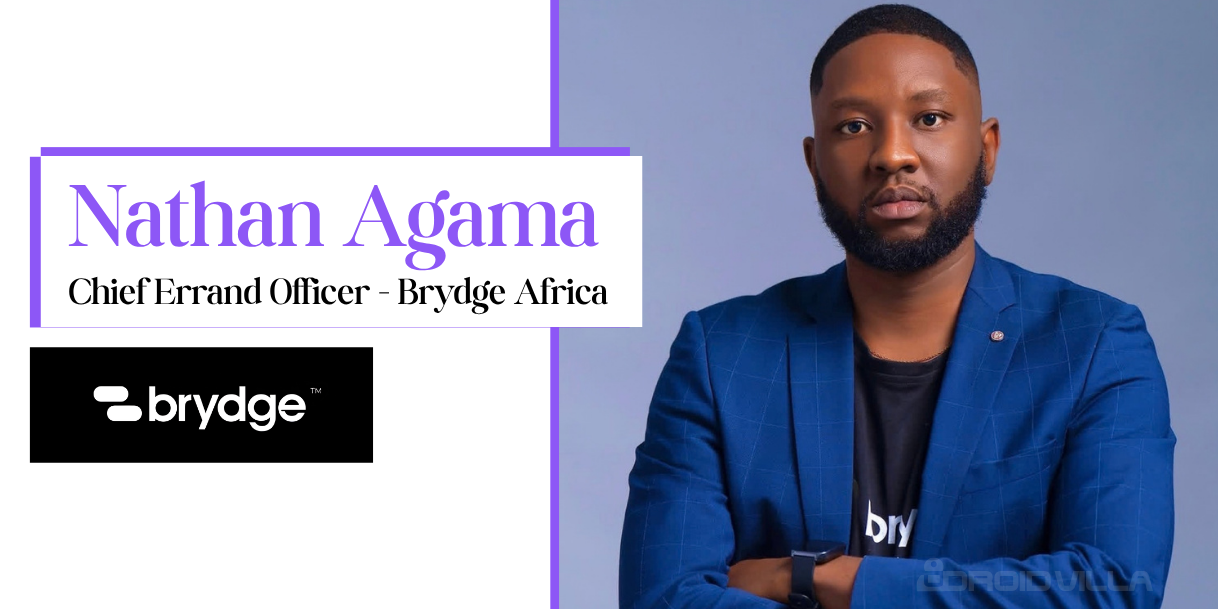
Building a company around a complex problem requires more than a promising idea. It requires persistence, continuous learning, and the willingness to take responsibility for the work that growth demands.
During our conversation with Nathan, one description stood out.
Rather than focusing on the conventional image of a chief executive, he described himself as a “Chief Errand Officer.”
The expression captured an important reality of entrepreneurship: founders are often involved in everything required to move their businesses forward.
From solving operational problems and building relationships to pursuing opportunities and keeping the team moving, the work of building a company can extend far beyond a job title.
For early-stage founders, this is a reminder that entrepreneurship is not always glamorous. Much of the work happens behind the scenes, through repeated decisions, difficult conversations, and responsibilities that do not necessarily attract public attention.
Nathan’s perspective reflected the practical side of building a business: the willingness to keep moving, solve problems, and do the work required to make progress.
What African Founders Can Learn From Nathan Agama
Beyond Brydge’s business model, the conversation offered lessons that other founders can take into their own journeys.
1. Build for the problem, not just the idea
A business becomes more meaningful when it addresses a real problem people experience.
Brydge’s evolution illustrates why founders must keep listening to the market. What begins as a solution to one challenge may reveal a wider opportunity once founders understand how customers operate.
The lesson is to remain close to the people you serve and allow what you learn to influence what you build.
2. Think beyond individual markets
Nathan highlighted the importance of making movement between African countries easier, including the need for more affordable intra-African air travel.
Trade depends on more than digital platforms. Transportation, logistics, payments, and other supporting systems all influence how easily businesses can operate across borders.
Improving these connections can create opportunities for entrepreneurs, suppliers, and customers across the continent.
3. Protect your health while building
Entrepreneurship can demand long hours, constant problem-solving, and significant personal sacrifice. But founders cannot afford to treat their well-being as an afterthought.
A key takeaway from the conversation was the importance of rest and taking care of one’s health while building a company.
Sustainable entrepreneurship requires more than ambition. It requires founders to recognise their limits and make room to recover.
4. Know when to rebuild
Not every idea, strategy, or project will work as expected.
Nathan’s reflections also highlighted the importance of recognising when something is not working and being willing to step away, rethink the approach, and rebuild.
Persistence does not mean repeating the same mistakes indefinitely. Sometimes, progress requires the courage to change direction.
For founders navigating uncertainty, the ability to learn from failure and make better decisions is part of the building process.
The Bigger Picture: A More Connected African Economy
Brydge’s work points to a larger question: what would African commerce look like if businesses could trade across borders with the same confidence they expect when working within their home markets?
Imagine a manufacturer finding verified suppliers in another African country, managing payments more efficiently, and tracking transactions without having to coordinate every stage through disconnected systems.
That is the kind of friction Brydge is working to reduce.
Realising this vision will require continued collaboration between technology companies, financial institutions, logistics providers, policymakers, and the businesses that rely on these systems every day.
It will also require solutions that account for the realities of African markets rather than simply importing approaches designed for different environments.
Brydge is positioning itself to contribute to that future by connecting the processes that enable businesses to trade.
Why Droidvilla Spotlighted Brydge Africa
At Droidvilla, we believe that the stories behind emerging technology companies deserve to be heard.
Behind every startup is a founder making decisions, solving problems, navigating uncertainty, and working to turn an idea into something useful.
Our Founder Spotlight series creates room for these conversations, giving founders an opportunity to explain what they are building, the problems they are addressing, the lessons they have learned, and the future they hope to shape.
Our conversation with Nathan Agama reinforced an important point: building a company is not only about the product. It is also about the people, decisions, and persistence behind it.
Brydge Africa represents one approach to addressing the challenges of cross-border trade, while Nathan’s reflections offer lessons for anyone working to build something meaningful.
As African technology continues to evolve, stories like these deserve greater visibility.
The future of African trade will depend not only on the opportunities we identify, but also on the infrastructure we build to make those opportunities accessible.
And for founders building that future, the work continues.
From Trade Technology to RetailTech: Another Founder Building for Africa
Brydge Africa is working to simplify cross-border trade, but the innovation happening across Africa extends beyond trade and payments.
In Droidvilla Founder Spotlight Episode 01, we featured Okam Solomon, Founder of Guida, who is building a RetailTech company focused on transforming how households access essential supplies.
Guida uses estimation technology to anticipate household needs and automate recurring purchases, starting with water and expanding towards groceries and other everyday essentials. Its approach aims to make household shopping more convenient by helping people get what they need before they run out.
While Brydge Africa is addressing the challenges businesses face when trading across borders, Guida is exploring how technology can make everyday household commerce more predictable and convenient.
Both companies operate in different sectors, but their stories share a common thread: using technology to solve practical problems and improve how people and businesses operate.
From cross-border trade to household commerce, these founders demonstrate the range of problems African startups are working to solve.
At Droidvilla, these are the stories we want to bring forward, founders building beyond ideas, challenging existing processes, and creating solutions with the potential to shape their industries.
Read our Founder Spotlight on Guida: Guida: How Okam Solomon Is Building a Smarter Household Commerce Platform in Nigeria
About Brydge Africa
Brydge is a trade technology company helping businesses source, verify, pay, and track cross-border deals across African markets. Its platform brings together trade management, payments, invoicing, and trade finance solutions.
Website: https://www.brydge.africa/
About Droidvilla Founder Spotlight
Droidvilla Founder Spotlight is a platform for conversations with founders and emerging technology companies building solutions across Africa and beyond. Through these features, Droidvilla aims to increase visibility for innovative businesses and share the stories, experiences, and lessons behind their journeys.